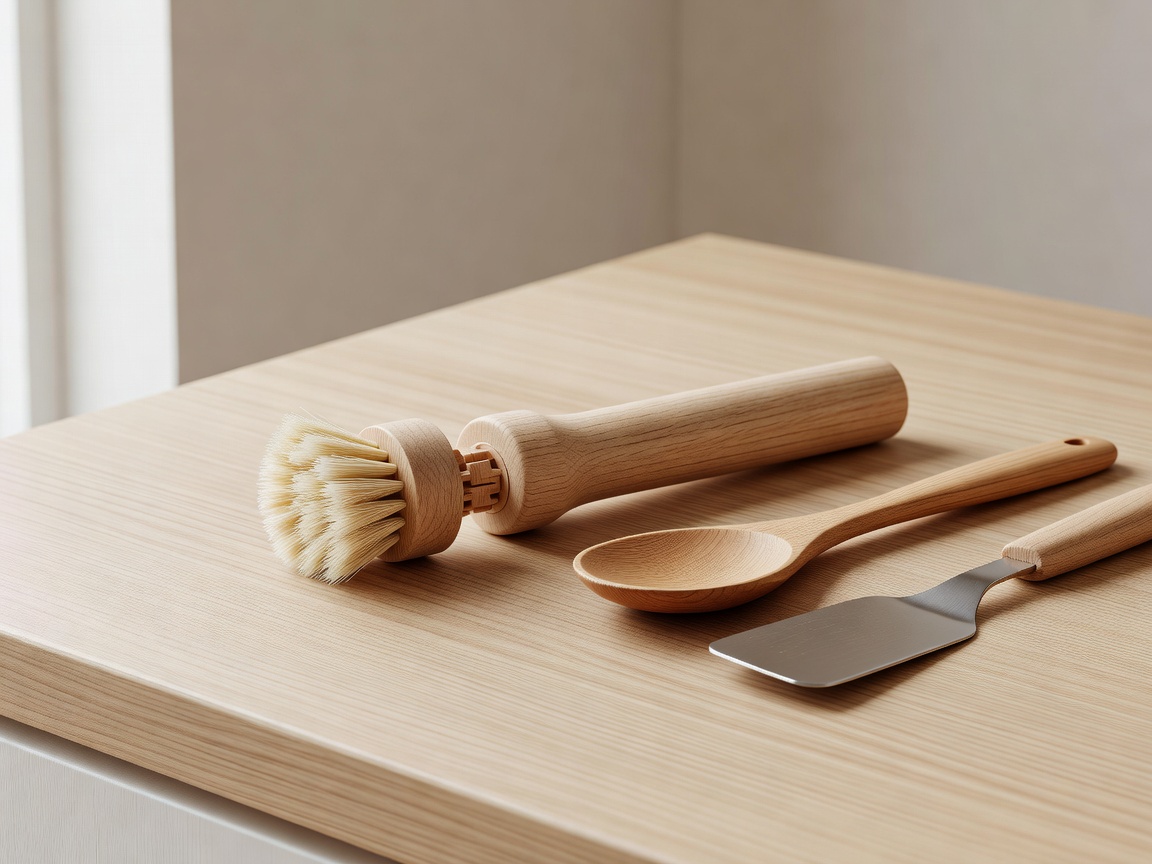
Keep the useful tool in the drawer
Start with the things you use most often. A comfortable spatula, a reliable peeler and a brush that dries well may matter more than a large collection of specialist gadgets. If an existing tool remains safe, effective and easy to clean, a plastic-free replacement is not automatically a worthwhile purchase.
Notice the actual problem before shopping. A blunt blade may need appropriate sharpening or professional attention. A loose handle may have a serviceable fastening. A brush with worn bristles may accept a replacement head. Repair only where the result is safe and the manufacturer permits it; adhesive or improvised parts are not necessarily suitable for heat or food contact.
Match the material to your cookware
Stainless steel utensils can be strong and easy to clean, but metal edges may damage some coated pans. Wood can be comfortable and gentle on cookware, yet it needs suitable washing and thorough drying. Silicone tools can tolerate heat within their stated limits, but one product's temperature rating should not be assumed for another.
Look beyond the headline material. A “wooden” tool may include glue, coatings or metal fastenings. A metal utensil may have a plastic handle that makes it easier to grip safely. “Plastic-free” describes a material choice, not a complete measure of suitability, durability or environmental impact. Prioritize a tool you can use safely and maintain consistently.
Check construction before appearance
Hold a tool if you can. Is it comfortable when wet? Can you control it without excessive grip force? Are there crevices that trap food, sharp unfinished edges or joints that already feel loose? Accessibility and comfort are legitimate reasons to prefer one design over another, including designs that use mixed materials.
For a replaceable-head brush, identify the exact replacement before purchasing the handle. Check availability, attachment method and whether the supplier gives clear compatibility information. A replaceable part is only a practical advantage if it can be obtained when needed. Buying a reasonable spare may help, but accumulating a lifetime of uncertain replacements creates another storage problem.
Material and care, side by side
| Tool or material | Useful quality | Care question |
|---|---|---|
| Wooden utensil | Comfortable, often gentle on pans | Can it dry fully without prolonged soaking? |
| Stainless steel tool | Strong and often straightforward to wash | Is it suitable for your cookware and grip? |
| Silicone utensil | Flexible working edge | Are temperature limits and joint cleaning clear? |
| Replaceable-head brush | Retains the handle when bristles wear | Are compatible heads readily available? |
| Washable cloth | Can join a repeated cleaning rotation | Can you separate tasks, wash and dry it reliably? |
Build a drying routine
Water left around joints and dense bristles can shorten a tool's useful life. After cleaning, let items drain and dry with airflow rather than leaving them in a wet sink. Follow product guidance for dishwashers: a washable working end does not necessarily mean a glued handle or removable component tolerates the same cycle.
Check wooden items for cracks, splinters and persistent damage. Follow the maker's advice if conditioning is recommended, using a product appropriate for the intended food-contact use. Do not attempt to rescue a tool whose damage makes it unsafe or impossible to clean effectively just to avoid replacement.
Choose plastic-free alternatives selectively
Washable cloths can reduce reliance on disposable towels for suitable everyday tasks, but they need a clean supply, a place for used cloths and an effective laundry routine. Separate food-contact cleaning from bathroom or heavily contaminated tasks. For some messes, a disposable item may be the safer or more practical option; one exception does not invalidate a broader reuse habit.
Reusable food wraps also have limits. Check their instructions for food types, temperature and washing. Some coated wraps are not intended for raw meat, hot food or high-temperature cleaning. A rigid container with a lid may be simpler for leftovers. Choose the format that safely suits the food rather than treating every disposable product as needing a direct reusable imitation.
Read environmental claims with care
Terms such as biodegradable and compostable need conditions and a disposal route. A compostable claim does not mean an item belongs in a home compost heap, and a local organics service may reject it. The standards ASTM D6400 and EN 13432 concern defined compostability requirements; they do not promise that a whole household product will break down in any environment.
For purchasing context, Forest Stewardship Council and PEFC certification can inform questions about forest-based sourcing. Check the actual product and claim rather than assuming every item from a brand shares a certification. ISO 14040 and ISO 14044 provide frameworks for life-cycle assessment, but a broad “eco” label is not itself a life-cycle comparison.